
Ethiopia

About
Ethiopia has experienced a series of internal and international armed conflicts throughout its history, leaving a legacy of landmines and explosive remnants of war (ERW) scattered throughout the country. According to Ethiopia’s latest Anti-Personnel Mine Ban Convention (APMBC) transparency report, the remaining suspected and confirmed contamination is 125,177,647 square metres.
The outbreak of conflict in November 2020 between the central government and the regional authorities of the Tigray region, which spilled over into the neighboring Afar and Amhara regions in 2021, has added new explosive ordnance contamination that poses an immediate threat to life and livelihoods. Since January 2020, 1,676 victims of explosive ordnance have been reported (189 girls, 870 boys, 156 women, 434 men) in northern Ethiopia, although not all cases have yet been verified. It is believed that many other accidents go unreported. Initial analysis shows that children make up more than 63% of all known casualties.
UNMAS deployed to Ethiopia in 2021 at the request of the UN Resident Coordinator, endorsing a request from the government of Ethiopia to undertake mine action activities following the outbreak of conflict in Tigray in 2020 and support the humanitarian response. In 2021, UNMAS facilitated the activation of the Mine Action Area of Responsibility (AoR) within the Protection Cluster, and in March 2022, UNMAS began conducting initial explosive ordnance assessments in northern Ethiopia as well as EORE by employing national non-governmental organization (NGO) partners. UNMAS expanded its presence in March 2023 by establishing field offices in Tigray and Afar, reinforcing its commitment to enabling humanitarian aid and operational delivery.
In late 2024, UNMAS facilitated a landmark meeting in Mekelle, Tigray, bringing together the Director of the Ethiopian Mine Action Office (EMAO) and Tigrayan authorities to initiate discussions on the resumption of mine action activities. This followed sustained advocacy that led the Government of Ethiopia to accredit six international NGOs in November 2024, marking a turning point in humanitarian mine action. With NGO deployments underway in Tigray and Afar, in June 2025, UNMAS strategically repositioned to the Amhara region. Aligning with the Government’s request to prioritize institutional strengthening, UNMAS also now focuses on building the EMAO’s capacity in accreditation, quality management, and information systems—serving as a critical enabler of nationally led, coordinated, and sustainable mine action efforts.
Impact
From January 2024 to November 2025
Explosive Ordnance Risk Education (EORE) teams funded by UNMAS have reached 90,332 beneficiaries (26,009 girls, 28,844 boys, 18,6218 women, 16,858 men) in Afar, Amhara, and Tigray, raising awareness on explosive ordinance risk and promoting safer behavior among conflict affected communities.
Community Focal Point (CFP) training was conducted to strengthen community-level capacity for EORE delivery and EO risk reporting in hard-to-reach areas of the Amhara region. In October 2025, UNMAS trained nearly 100 focal points who identified suspected EO locations and highlighted key risks, including informal scrap use of ERW, while underscoring the need for EORE targeted at children and youth. Following the training, CFPs commenced community sensitization activities, reaching more than 2,000 people with EORE.
A total of 103 Explosive Hazard Awareness Training (EHAT) sessions have been provided to 1,802 humanitarian personnel (378 women, 1,4244 men), contributing to increased safety and security for aid workers. Participants included representatives from UN agencies, NGOs, government institutions, and other stakeholders such as casual laborers, contractors, religious associations, and community groups.
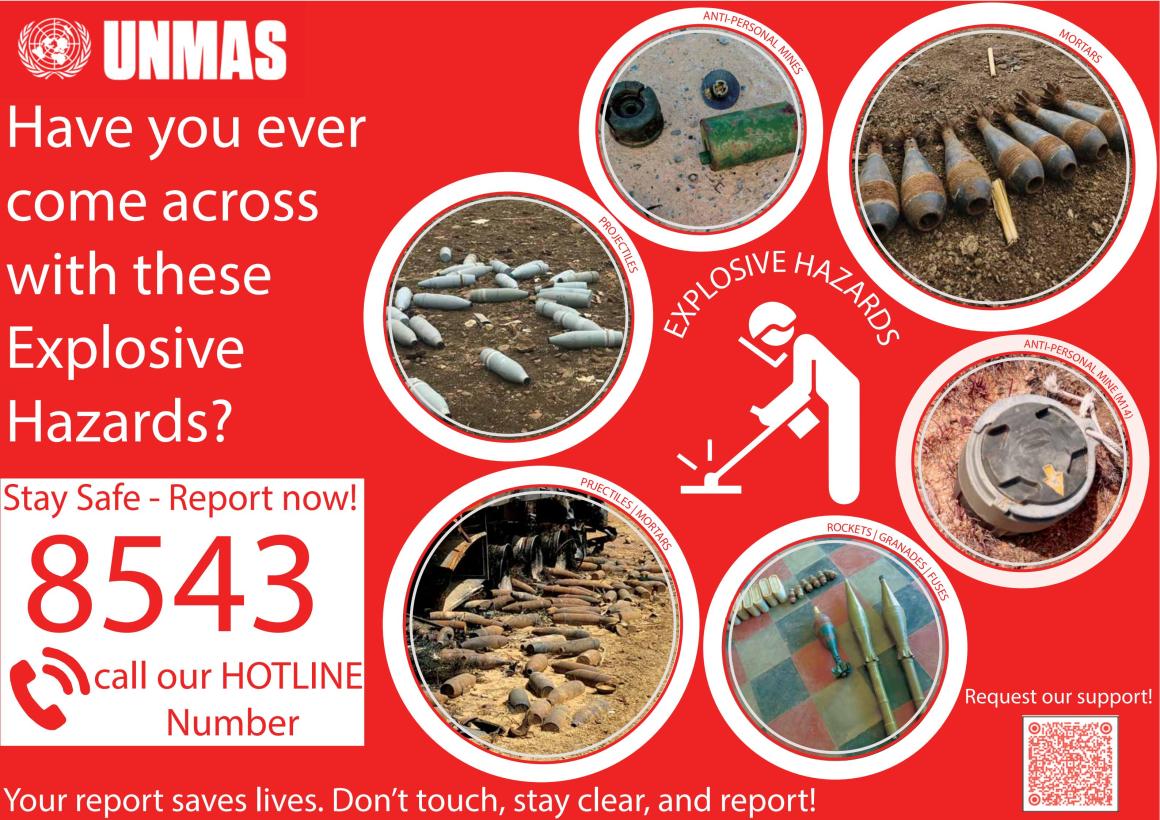
UNMAS technical personnel deployed to Afar, Amhara and Tigray regions and assessed 329 areas (89 woredas) reported by humanitarian partners as suspected of explosive ordnance contamination, with over 3,000 such items being reported, including among others, 881 projectiles, 149 rockets, 566 mortars, 1,113 fuses, 20 air dropped bombs, 42 grenades, 7 anti-personnel mines and 170 small arms ammunition. 619 items have since been removed for disposal, while the remaining were marked and reported to authorities.
Activities
Explosive Ordnance Threat Assessment
UNMAS personnel have deployed to Tigray, Afar, and Amhara regions to conduct explosive risk assessments in humanitarian partners’ areas of intervention. In 2024, at EMAO's request, UNMAS facilitated the release of 600 square kilometres of land that had been erroneously recorded in the EMAO database, in accordance with international standards and best practices, thereby ensuring the land is returned to the community for development.
UNMAS rapid assessments have directly enabled the safe resumption of humanitarian operations, including food distribution by NGO partners. Since January 2024, UNMAS technical teams in Amhara, Afar, and Tigray have assessed 329 areas across 89 woredas reported as suspected of explosive ordnance contamination. In Amhara alone, from March 2025, assessments were conducted in 21 woredas covering 46 kebelles.
Also, in Tigray, similar assessments and creations of awareness allowed the reopening of (29) schools, restoration of (15) health facilities, reactivation of (10) water points, and the establishment of (4) law enforcement facilities. Through these interventions, UNMAS is creating safer conditions for stability, humanitarian access, and broader community recovery.
Explosive Ordnance Risk Education (EORE)
UNMAS provides Explosive Hazard Awareness Training to 1,802 humanitarian personnel to ensure the safe delivery of aid in contaminated areas. In partnership with local organizations, UNMAS also delivers gender, age, and diversity-sensitive risk education to at-risk communities, Internally Displaced People (IDPs), and returnees across northern Ethiopia. To date, these efforts have reached over 90,332 beneficiaries.
Humanitarian Coordination
UNMAS leads the Mine Action Area of Responsibility (AoR) of the humanitarian architecture, ensuring mine action partners coordinate needs assessments and operations, share analysis, establish links with other key sectors such as Child Protection, Education, and Health, and jointly advocate for increased access to resources.
Technical Assistance & Capacity Development
UNMAS is providing technical assistance to the Ethiopian Mine Action Office (EMAO), providing specialised training and mentoring to EMAO staff, supporting the operationalization of EMAO’s mine action information management system, and assisting EMAO with the implementation of quality control and quality assurance of mine action operators.
Funding
UNMAS is grateful for the direct contribution of donors to enable its mine action activities in Ethiopia. From January 2024, UNMAS operations relied on generous contributions from the Governments of Canada, Denmark, Korea, Japan, and the Central Emergency Response Fund (CERF).
UNMAS Ethiopia is seeking funding to maintain and strengthen its humanitarian mine action activities in northern Ethiopia and to support the Ethiopian Mine Action Office (EMAO) with technical assistance and capacity development, ensuring effective oversight and coordination of the mine action sector through 2026.
Data as of January 2026
Programme Quick Facts
Established
2021
Number of Suspected Areas Assessed
329 areas (89 woredas)
Explosive Ordnance (EO) Removed
619 items
Humanitarian Personnel Trained
1,802
Explosive Ordnance Risk Education Reached
90,332 people
Resources
- Ethiopia & Sudan: Mine Action - Press Conference at United Nations
- UNMAS Ethiopia: Training and Services
- UNMAS Ethiopia: Call for Assistance
Programme Latest News

- News
UNMAS Welcomes the Contribution from Denmark for Mine Action in Ethiopia

- News
Japan Helping the People of Ethiopia

- News