
Ukraine

About
Ukraine is experiencing the most extensive explosive ordnance (EO) contamination challenge in the world today as a direct result of Russia’s full-scale invasion in 2022 and ongoing hostilities. As of mid-2025, national estimates indicate that roughly 25% of Ukraine’s territory—more than 139,000 km² of land, a size greater than England and Wales combined—is suspected of contamination.
The highest levels are concentrated in eastern (Kharkiv, Donetsk) and southern (Kherson, Mykolaiv) regions, in areas affected by prolonged ground fighting, occupation, and heavy shelling, but EO hazards of nearly all conventional types have been recorded across Ukraine, including anti-personnel and anti-vehicle mines, cluster munition remnants, unexploded aerial ordnance, abandoned explosive ordnance, and improvised explosive devices (IEDs). These hazards affect agricultural land, residential areas, forests, transport corridors, waterways, and critical energy infrastructure, driving prolonged displacement and inability for people to return home. It is an exceptional breadth and intensity of contamination rarely encountered in contemporary conflict settings.
Evolving EO Aerial Threats
More recently, the proliferation of first-person-view (FPV) drones, short-range unmanned aerial vehicles (UAVs), and loitering munitions has created a new landscape of unstable, movement-sensitive unexploded ordnance (UXO) in civilian areas. In frontline oblasts like Kherson, UAV-delivered explosives have become a leading cause of civilian casualties, with hundreds of attacks recorded weekly. These systems frequently result in downed or entangled drones with intact payloads, requiring National Police and SESU EOD teams to rapidly develop specialized extraction, render-safe, and forensic procedures.
The Impact of This Contamination
- Since February 2022, over 1,150 civilians have been killed or injured by landmines and explosive remnants of war (ERW).
- Approximately 67% of Ukraine’s suspected hazardous areas are agricultural, threatening the agrarian economy and global food supply. While 512,000 hectares of priority land were successfully cleared and returned to use by late 2025, an additional 328,000 hectares of high-value arable land still require urgent assessment.
- Real and perceived contamination in Ukraine affect global food and energy prices. Global food security is improved as land suspected of contamination, or land cleared, is turned back into agricultural production.
- EO hazards cost Ukraine $11.2 billion annually, with agricultural exports currently down by $4.3 billion per year.
- EO clearance is the prerequisite for Ukraine’s $524 billion reconstruction. Critical repairs are stalled, with $13 billion needed just for debris management across housing, transport, and energy sectors.
- More than 3.7 million people remain internally displaced, with the fear of EO as the primary deterrent to return. This hazard is a daily reality for the 5.4 million people still living in directly exposed war zones where EO has been documented.
- The cost for full demining is estimated at $34.6 billion over ten years. Every $1 invested in humanitarian demining is projected to return $4 in economic benefits through GDP growth and job creation.
United for Mine Action
UN in Ukraine continues mine action activities to support people of Ukraine for long-term solutions under the leadership of the Resident and Humanitarian Coordinator in collaboration with over a dozen UN entities contributing to the mandates.
Since 2022, UNMAS provides high-level strategic and policy advisory expertise and sector-wide coordination, partnered with UNDP’s long-standing operational presence in Ukraine to integrate mine action into recovery and development processes. Additionally, support to the national government and local actors, enabling nationally led implementation and systems development has been a longstanding priority.
Within this framework, a core group of UN agencies — UNDP, FAO, UNICEF, UNOPS, and WFP — supports large-scale mine action delivery and the integration of clearance, risk education, and institutional strengthening into recovery, agricultural revitalization, and infrastructure rehabilitation efforts.
Other UN entities, including UN Women, UNFPA, WHO, UNHCR, IOM, OHCHR, and UNEP, contribute mandate-specific expertise and cross-cutting outcomes in protection, health, displacement, gender equality, human rights, and environmental safeguards.
Ukraine’s mine action sector is complex and rapidly evolving, with more than 100 stakeholders, including 80 certified operators and at least 23 government entities. UN mine action activities are delivered in support of national institutions, including the Ministry of Economy, the National Mine Action Authority, the Center for Humanitarian Demining, the State Emergency Service of Ukraine, and National Police EOD units.
As contamination expanded nationwide, UN coordination mechanisms adapted; accordingly, in July 2023, the Mine Action Sub-Cluster transitioned into the Mine Action Area of Responsibility (MA AoR) to strengthen inter-agency coordination and alignment with humanitarian mine action priorities. UN engagement is guided by Ukraine’s National Mine Action Strategy (2023–2033) and aligned with the UN Sustainable Development Cooperation Framework (2025–2029).
Impact and Activities (2022–2025)
- Life-Saving Awareness and Risk Reduction: UNICEF-led Explosive Ordnance Risk Education (EORE) has reached over 2.3 million people, including 760,000 children and 540,000 displaced persons, with tailored outreach for displaced populations by UNHCR and IOM. These programs are critical in addressing the persistent threat of remotely delivered mines which can re-contaminate previously cleared areas and pose a high risk to unsuspecting civilians.
- Operational Capacity and Technical Scaling: UNOPS has supported the procurement and delivery of millions of dollars’ worth of specialized demining equipment, including armored vehicles, remote-controlled demining machines, and detectors, to the State Emergency Service of Ukraine and National Police. This support has contributed to strengthening national technical capacity for survey, clearance, and EOD.
- Economic Restoration and Strategic Prioritization: Technical support from UNDP and FAO with geospatial mapping and soil analysis tools has enabled the identification and prioritization of suspected agricultural land for clearance based on productivity and economic value.
- Agricultural Recovery and Livelihoods: Working with demining operators, FAO and WFP supported the clearance of farmland in Kharkiv, Kherson, and Mykolaiv, directly benefiting nearly 2,000 smallholder farmers.
- Healthcare and Survivor Support: WHO and UNFPA have strengthened national health pathways to provide trauma care, prosthetics, and psychosocial support (MHPSS) to thousands of survivors, ensuring their long-term social and economic reintegration.
- Safe Returns: By aligning IOM’s displacement tracking with hazard mapping, the UN facilitated the safe, voluntary return of portions of Ukraine’s 3.7 million IDPs.
- Gender Equality & Inclusion: UN Women ensures that mine action is not just a technical activity but a driver of social change, promoting gender-inclusive employment where women are increasingly represented in technical demining and leadership roles across the sector.
- Human Rights & Protection: OHCHR monitors and documents the impact of EO on civilian rights, ensuring that mine action efforts are aligned with international humanitarian law and the rights of victims to assistance and reparations.
- Environmental Safeguards: UNEP provides the technical protocols to ensure land release is environmentally sustainable, focusing on preventing soil degradation and water contamination during the clearance of complex EO and military debris.
- National Systems and Governance: The UN has worked with national counterparts to strengthen sector-wide cohesion, improve mine action governance, and enhance data and quality management systems. Support has included the adoption of Ukraine’s National Mine Action Strategy (2023–2033) and revision of National Mine Action Standards, and the establishment of coordination platforms for planning, oversight, and policy development.
Funding
Although tens of millions of dollars have been mobilized annually for mine action in Ukraine since 2022, the unprecedented scale of contamination means that needs still vastly exceed available resources. The task will require sustained investment over the coming years. According to the latest Rapid Damage and
Needs Assessment report, conducted jointly by the World Bank, the UN, and the EU, the cost of comprehensive mine action could exceed USD 34.6 billion over the next decade. Funding supports land prioritization, survey, and clearance, and a wide range of activities including procurement, EORE, institutional capacity strengthening, and victim assistance.
Since February 2022, UN mine action activities have been supported by more than 22 countries and the EU, including Canada, Japan, Denmark, Germany, Switzerland, and the United States. Contributions are made through direct bilateral aid, including in-kind contributions, or through UN-managed country-level pooled funding mechanisms:
- Ukraine Community Recovery Fund (UCRF): Managed by the UN Resident Coordinator’s Office, with a dedicated mine action window for localized, community-level interventions.
- Ukraine Humanitarian Fund (UHF): Managed by OCHA to support immediate, life-saving emergency activities.
- Voluntary Trust Fund for Mine Action (VTFMA): Administered by UNMAS, supping delivery of mine action projects aligned with Ukraine’s National Mine Action Strategy.
Looking Ahead
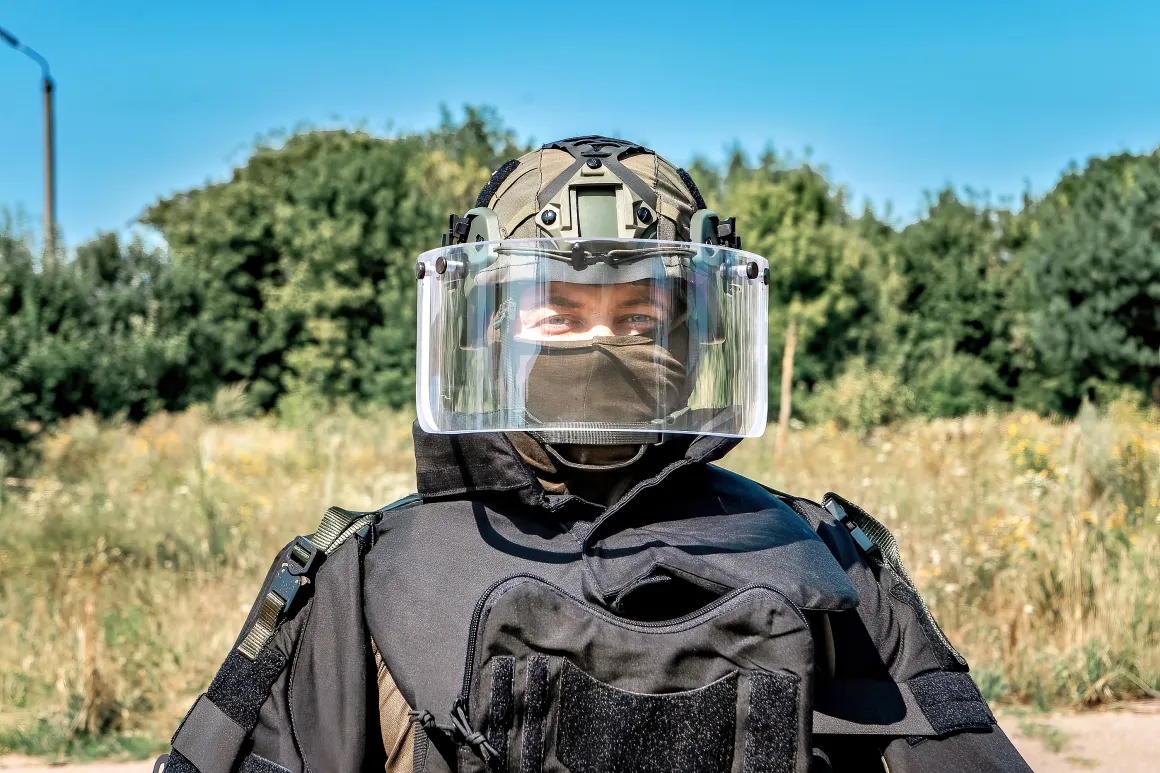
Ukraine is laying the groundwork for a more sustainable, people centered and nationally led mine action system integrated with broader recovery and reconstruction priorities. Strengthening national coordination, accelerating land release, and expanding support to affected communities will remain key. At the same time, Ukraine is emerging as a global hub for mine action innovation, piloting drones, AI, and advanced analytics to transform traditional survey and clearance operations and reduce the timeline and cost of manual demining. UNMAS is supporting efforts to translate these innovation pilots into scalable, system-level tools that can be safely integrated into national operations. These advancements offer technical lessons that can benefit mine action efforts globally, accelerating progress toward a mine-free world.


Programme Quick Facts
Established
2022
Explosive Ordnance Risk Education Reached
2.3 million people (UNICEF-led)
Land Released
Benefiting nearly 2,000 smallholder farmers
Safe Returns of Internal Displaced Populations (IDPs)
3.7 million
Resources
- Paul's Heslop article on Mine Action in Ukraine
- UNMAS Film Festival 2026: Land of Silence
- UNMAS Ukraine Videos
- Ukraine Humanitarian Needs and Response Plan 2026