

Nigeria

About
"Even after the fighting stops, conflicts often leave behind a terrifying legacy: landmines & explosive ordnance. We must take action to end the threat of these devices of death & help people return & re-build their lives in safety & security."
-Mr. Antonio Guterres, Secretary-General of the United Nations
The conflict in northeast Nigeria, which started in 2009, is a protracted non-international armed conflict involving Boko Haram, ISWAP, and other non-state armed groups (NSAG). The conflict has caused massive displacement, severe food insecurity and malnutrition, and a humanitarian crisis impacting today over two million people. In addition, it has caused widespread displacements, civilian deaths and severe injuries, disrupted access to basic social services and livelihoods, contributed to food insecurity, and impeded the safe return of internally displaced persons (IDPs) and refugees, as well as the free movement of host community members. Over seventeen years of armed conflict have left a pervasive legacy of explosive remnants of war (ERW). Improvised explosive devices (IEDs) remain the weapon of choice for non-state armed groups (NSAGs), and their extensive use has further exacerbated the vulnerability of IDP returnees and host communities across the northeastern states of Borno, Adamawa, and Yobe (BAY). The operating environment remains extremely volatile, particularly in Borno State, where major supply routes continue to be dangerous to civilians and humanitarian workers due to the risk of attacks by NSAGs, as well as from IEDs/ antipersonnel mines of an improvised nature.
According to the Landmine Monitor 2025, Nigeria now ranks fifth globally in countries with more than 100 landmine and explosive ordnance casualties, reflecting an increase in risks and casualties compared to its sixth-place ranking in the previous year’s Monitor report. Additionally, the Global Terrorism Index ranks Nigeria as 6th in 2025.
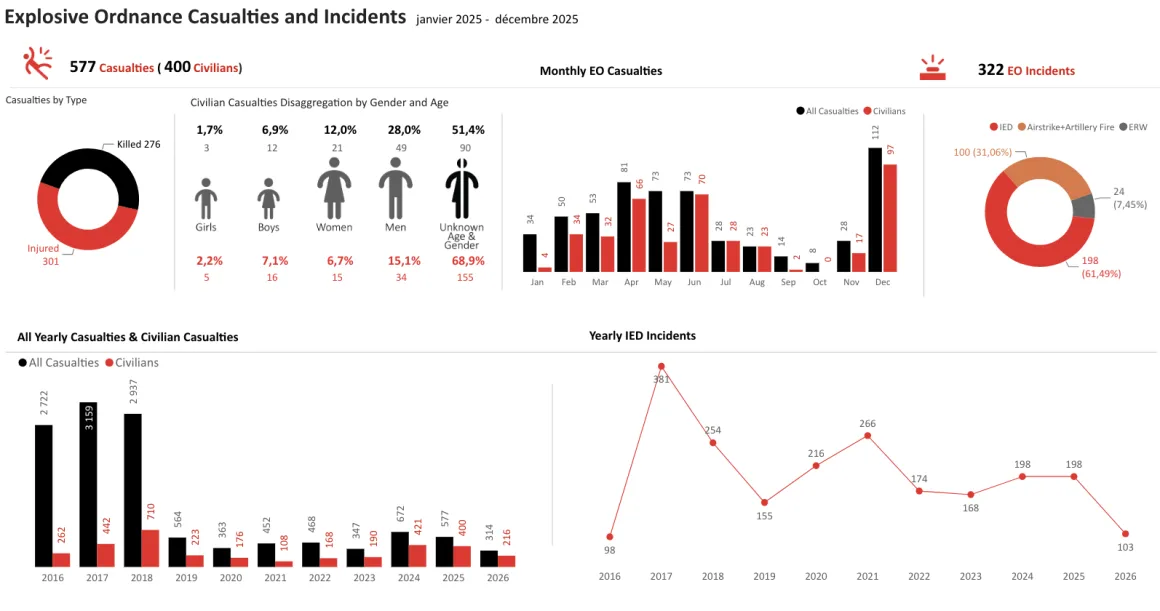
In 2021, the Borno State Government (BSG) announced it would close all IDP camps in the Maiduguri Metropolitan Council (MMC) and relocate them to their villages of origin. The closure of the camps has affected over 160,000 individuals. With the Nigerian Government’s IDP camp closure and decongestion policy, civilians are returning to areas that remain at risk of explosive ordnance threats, with 83% of EO civilian casualties registered in Borno state in 2025 recorded in 13 of 15 local government areas of return.
Between 2016 and 2025, a total of 3,404 people were injured (including 2,019 civilians), and 9,122 (including 1,308 civilians) were killed as a result of explosive ordnance. In 2025 alone, 329 explosive ordnance incidents (195 IED incidents), were recorded in northeast Nigeria, resulting in 574 casualties, including 401 civilians. In northwest and northcentral Nigeria, 65 explosive ordnance incidents (22 IED incidents), were recorded which resulted in 71 casualties (62 civilians). The number of explosive-ordnance incidents rose from 267 in 2024 to 329 in 2025 (22% increase in 2025 relative to 2024). In 2025, NSAGs continued using IEDs, which represent 60% of all EO incidents and resulted in 90% of the civilian casualties in 2025. IEDs were placed along routes, and as vehicle-borne IEDs and person-borne IEDs, including in the Borno state capital, Maiduguri. Increasingly sophisticated IEDs used in ambushes, illegal checkpoints, vehicle-borne, and attacks on civilians and aid workers have heightened risks for communities and first responders. ERW remains a threat to the civilian population, including for agricultural activities. The use of unmanned aerial vehicles (drones) and the discovery of cluster submunitions in agricultural lands further underscores the evolving nature of contamination.
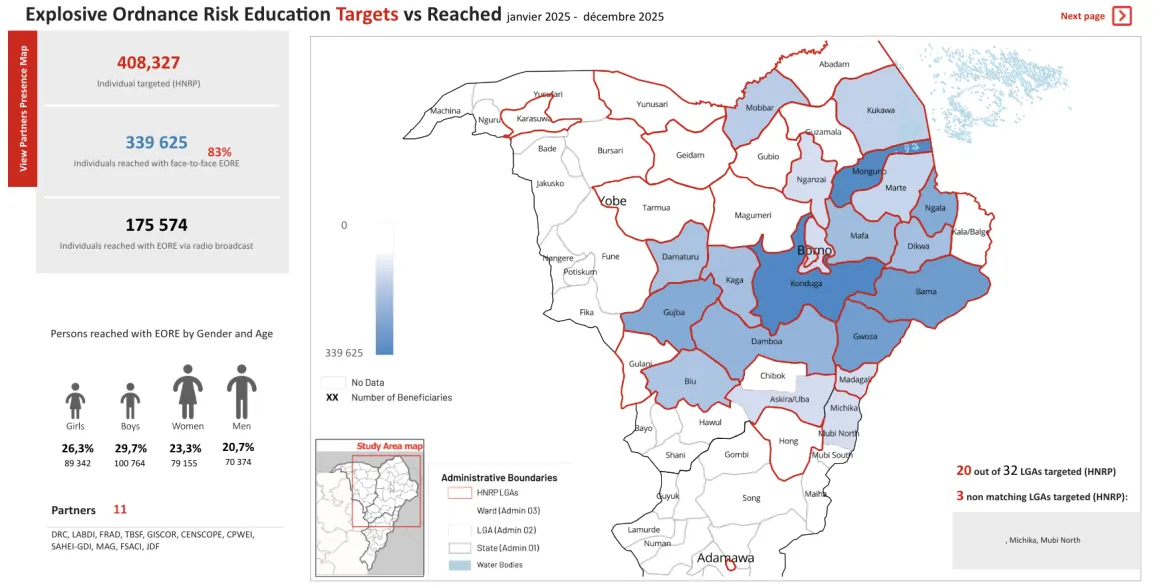
According to the 2025 Humanitarian Needs and Response Plan, 7.8 million people are in need of humanitarian assistance in northeast Nigeria, of which 1.8 million were identified as in need of mine action activities. The mine action Area of Responsibilities (AoR) targeted a reach of 425,246 beneficiaries as priority across 32 local governmental areas (LGAs).
Nigeria is a party to the Anti-Personnel Mine Ban Convention (APMBC) and the Convention on Cluster Munitions.
In December 2011, at the 11th Meeting of the States Parties, Nigeria presented a formal declaration of completion of the destruction of anti-personnel mines. However, in 2019, at the Fourth Review conference, Nigeria reported contamination in the northeast as a result of the conflict. In 2024, a request for extension of its obligations under Article 5 of the APMBC until 2025 was submitted and endorsed at the 22nd Meeting of State Parties until the 31st December 2028. As part of the commitment to the APMBC, the Government of Nigeria committed to establish a National Mine Action Centre (NMAC). The NMAC was established in April 2024 and is being operationalized. As of today, mine action partners operating in northeast Nigeria coordinate under the mine action working group (MAWG), led by the NMAC and UNMAS.
Nigeria signed the Convention on Cluster Munitions on 12 June 2009 and ratified it on 28 February 2023, making Nigeria the 111th State Party. The Convention entered into force on 1 August 2023.
Impact
UNMAS deployed in July 2018 at the request of the UN Resident/Humanitarian Coordinator to: (1) provide technical assistance including coordination, planning and technical advice and support to the Humanitarian Country Team, the humanitarian community, population affected by the EO threat and national authorities; (2) as the focal point within the United Nations for mine action related matters in the northeast; and (3) plan for the wide-scale delivery of emergency lifesaving risk reduction, survey and clearance operations.. Current activities include coordination, explosive ordnance risk reduction, victim assistance, training security forces in explosive ordnance disposal/IED threat mitigation, and capacity development for the national mine action authorities..
As of 31st December 2026, UNMAS Nigeria has achieved the following outputs.
Explosive Ordnance Risk Education (EORE). 2,767,025 (596,167 men, 689,034 women, 783,583 boys and 698,241 girls) reached by explosive ordnance risk education (EORE) sessions. 1,497 personnel from civil society organizations, community volunteers and national and state authorities underwent EORE training. 2,749 humanitarian workers (including 1,233 UN personnel) attended explosive ordnance awareness (EOA) sessions. UNMAS delivered EORE ToT courses for 124 Nigeria Security and Civil Defense Corps (NSCDC) and the Nigeria Police Force (NPF) officers, with 94 officers successfully completing the ToT. In addition, 25 NPF officers were trained by the ToT personnel as part of the rollout programme. These officers have reached more than 13,000 people across several at-risk LGAs in Northeast Nigeria.
Explosive Ordnance Disposal/Improvised explosive device disposal. In 2025, 54 Nigerian security forces officers underwent an Explosive Hazard Awareness Training (EHAT), 25 participated in an All Arms Search Course (AASC), 20 were trained in individual first aid kits (IFAK), and 20 successfully completed the Conventional Munitions Disposal (CMD) Level 1 & CMD-2 course and 15 completed the CMD-level 3 course. 15 participants successfully completed the IED disposal in situ course in February 2026.
Activities
UNMAS Nigeria has developed a two-pillar approach to address risks and strengthen response capacities related to the threat from explosive ordnance (EO) and improvised explosive devices (IEDs) in Nigeria:
The first pillar, Humanitarian Response / Human Security, focuses on strengthening national capacities to address civilian risks and mitigate the humanitarian consequences of EO/IED incidents. This pillar is implemented through four complementary components: EORE, community liaison, victim assistance (VA), and support to the Ministry of Defence/NMAC. Through these activities, UNMAS Nigeria delivers a comprehensive approach that spans prevention, community-level capacity-building, and effective response mechanisms for affected populations and victims.
The second pillar, IED Threat Mitigation, focuses on enhancing the capacity of Nigeria’s security forces to counter IED threats. This is achieved through specialized training and technical support, as well as assistance to national authorities in developing a coordinated and comprehensive national approach to IED threat management.
Outside of its two operational pillars, UNMAS Nigeria has two more activities regarding “survey & marking” entailing data collection and management, a crucial task to assess risks and needs, and a second one on “advocacy & public information”, aimed at strengthening its capacity to collect, analyze, and disseminate critical data. These pillars will enhance information-sharing with the public, partners, and donors.
I - HUMANITARIAN RESPONSE/HUMAN SECURITY
- EORE is delivered to affected populations—including IDPs, returnees, host communities, refugees, as well as awareness sessions for humanitarian workers and UN staff—to reduce risks and promote safer behaviour. This includes activities conducted by NNGOs, building the capacities of local partners and local government officers (teachers, community development officers, social workers). EORE activities are also delivered by the trained officers from both the NPF and NSCDC. To refine its approach, UNMAS conducted two KAPB surveys in 2025, enabling the adaptation of risk education approaches to different demographics, unsafe behaviours and the evolving EO threat, including the increased use of IEDs. Awareness materials, radio messages, SMS, and pre-recorded messages in talking devices are designed for the specific context of Northeast Nigeria and to the specific needs of each gender, age, and diversity group. National EORE standards were developed in coordination with the Mine Action Sub-Working Group.
- Due to insecurity and active conflict limiting formal surveys, community liaisonis an essential component of the work, particularly in IDP camps and areas of return, with respect to conflict sensitivity concerns. Community liaison with men and women in explosive ordnance-affected communities aims to exchange information on the presence and impact of explosive ordnance. It creates a reporting link with the mine action programme and develops risk reduction strategies. Community liaison aims to ensure that the different community needs and priorities are central to the planning, implementation, and monitoring of mine action operations.
- UNMAS is supporting the Ministry of Defence/NMAC to operationalize the NMAC through the provision of technical advice. This includes technical advice towards the Government’s obligations under the Anti-Personnel Mine Ban Convention and the Convention on Cluster Munitions.
- With its local partners, UNMAS Nigeria continues to develop its victim assistance activities. In order to support survivors of explosive incidents and enable access to emergency and long-term medical assistance, psychological support and social inclusion, UNMAS Nigeria conducted a data collection and mapping of services, this enabled it to identify the needs of the survivors as well as the existing services and have established a referral mechanism. The referral system allowed effective identification of victims of EO incidents and determined their needs in terms of health, education, psychosocial support, or economic support, including identification of gender-based violence (GBV) among the survivors, and the needs of women and girls for further referrals. UNMAS supported 82 victims in 2023 and reached 234 victims of EOs with referrals, with 175 being supported in accessing medical, psychosocial, livelihood, and education services. A standard operating procedure for VA was also developed with the MAWG.
II - IED THREAT MITIGATION
In response to the persistent and adaptive IED threat environment, UNMAS is implementing a targeted capacity building programme (based on an assessment conducted in 2024 on the EOD capacity of the NPF and utilizing UN specialized training material) to enhance Nigeria's national IED threat mitigation and EOD operational capability. Following the 2024 technical assessment, a phased training and certification framework was initiated in 2025, aligned with IMAS standards and national threat context, beginning with EHAT, AASC, and CMD 1,2 & 3 for the selected NPF and NSCDC personnel. Training continued in early 2026 with IEDD to mitigate the IED threat in the northeast by conducting systematic IED detection, identification, rendersafe procedures, and disposal operations across complex threat scenarios. This operational expansion supports the establishment of task- organized IEDD/EOD and all arms search teams, integrated with appropriate equipment, SOPs, and command and control structures. UNMAS will maintain continued mentoring, quality assurance, and technical advisory support to ensure operational compliance, improve response effectiveness, and sustain long term national IED threat mitigation capacity.
III - Data collection & data management
- Beyond data collection, UNMAS Nigeria places strong emphasis on data management and presentation to ensure clear, timely, and accessible information-sharing with partners and donors. To this end, UNMAS has developed an interactive dashboard to support analysis, coordination, and informed decision-making.
IV - ADVOCACY & PUBLIC INFORMATION
- To strengthen its visibility and outreach, UNMAS Nigeria has progressively expanded its communication activities, reinforcing its online presence across official UNMAS platforms and United Nations Newsletters. These efforts support advocacy for UNMAS activities and highlight the critical importance of its programme.
- Looking ahead, UNMAS Nigeria aims to further enhance its advocacy and public information efforts through strategic collaborations, including partnerships with global peace advocates, to broaden awareness and engagement at national and international levels.
Funding
UNMAS is supporting the Nigeria Humanitarian Needs and Response Plan (HNRP) 2026, but also providing technical advice to the Government as well as strengthening the capacities of the security forces thanks to the generous support from the Governments of Japan, the United Kingdom, the United States, Republic of Korea, ECHO, and in partnership with the UN Internal Displacement Solution Fund, Japan International Cooperation Agency (JICA) and UNICEF. UNMAS in Nigeria also has in-kind contributions (personnel) from the Benue State Government and Switzerland.
The comprehensive mine action response in northeast Nigeria for 2025 has a projected cost of US$5.6 million. As of January 2026, the mine action sector faces a funding gap of approximately $2.5 million. UNMAS Nigeria operations are currently funded until the beginning of April 2026, and without securing additional contributions, activities will be scaled down.

Data as of 31st of December 2025


Programme Quick Facts
Established
2018
Non-Technical Surveys (NTS) Conducted
338
Humanitarian Workers Trained
1,793
Explosive Ordnance Risk Education Reached
1,877,333

Programme Latest News

- News
“Peace is not only the end of fighting”: UN Peace Advocate Visits UNMAS Programmes in Nigeria

- News
Breaking Barriers and Saving Lives !

- News